

Geometry & measures
Angles, polygons, congruence and similarity, Pythagoras, the circle theorems, mensuration and vectors.
Geometry rewards knowing your angle facts, area/volume formulae and the circle theorems cold. Most questions are short once you spot which fact applies.
Core facts: angles on a straight line sum to , around a point to ; vertically opposite angles are equal; with parallel lines, alternate and corresponding angles are equal.
For a polygon with sides, the interior angles sum to and the exterior angles always sum to . A regular -gon has each exterior angle .
Worked example
Each interior angle of a regular polygon is . How many sides?
Exterior angle , so
Pythagoras: in a right-angled triangle , with the hypotenuse. It works in 3D too via a right-angled triangle through the solid.
Similar shapes have equal angles and sides in a fixed ratio (the scale factor ). Then areas scale by and volumes by .
Worked example
Two similar cylinders have heights and ; the smaller has volume . Find the larger volume.
Scale factor , so volume scales by :
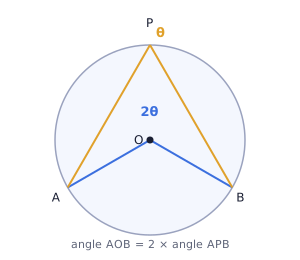
The standard theorems:
- The angle at the centre is twice the angle at the circumference on the same arc.
- The angle in a semicircle is .
- Angles in the same segment are equal.
- A tangent meets a radius at .
- Opposite angles of a cyclic quadrilateral sum to .
Worked example
is a diameter and lies on the circle. If angle , find angle .
The angle in a semicircle gives angle , so angle
Know these formulae:
- Circle: circumference , area .
- Cylinder: volume .
- A sector of angle : arc , area .
Formulae for spheres, cones and pyramids are given in the question if needed.
Worked example
A sector has radius and angle . Find its area (leave in terms of ).
A vector has magnitude and direction, written as a column . Add by adding components; multiply by a scalar to stretch. Parallel vectors are scalar multiples of each other.
Worked example
If and , then
- Scaling area or volume by instead of or .
- Mixing up which circle theorem applies (check what arc the angles stand on).
- Using degrees for the sector fraction wrongly: it is always .