

Graphs & functions
Straight lines, the standard curve shapes, gradients and areas under graphs, and reading kinematics graphs.
Graph questions reward recognition. If you know the shape of each standard function and what gradient and area *mean*, many questions become a few seconds of reading rather than algebra.
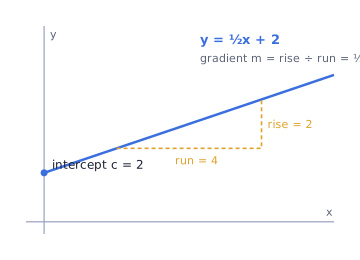
A straight line is , where is the gradient and the **-intercept**. Between two points, .
Parallel lines have equal gradients. Perpendicular gradients multiply to , i.e. .
Worked example
Find the line through perpendicular to .
Perpendicular gradient . Through : , so
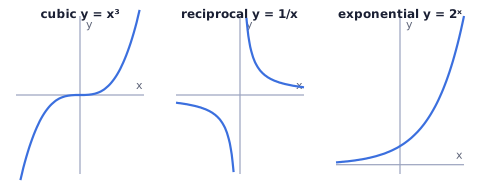
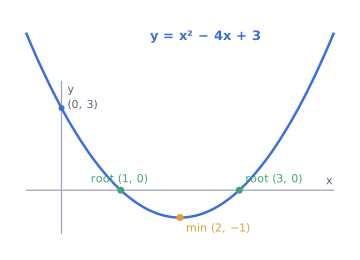
Know the families: linear (straight), quadratic (parabola), cubic (S-shaped), reciprocal (two branches, axes as asymptotes), and exponential (through , growing fast).
For a quadratic, the roots are where ; the curve is symmetric about the vertical line through its turning point.
On a real-context graph, the gradient is a rate of change and the area under the line often has physical meaning. You may be asked to *estimate* these for a curve.
On a distance–time graph the gradient is the speed. On a speed–time graph the gradient is the acceleration and the area underneath is the distance travelled.
Worked example
A speed–time graph rises from to over , then stays flat for . Find the distance.
Area triangle rectangle
Exam tip
When a question gives a graph "in context", translate it before calculating: ask *what does the gradient mean here?* and *what does the area mean here?*
- Using for parallel lines instead of perpendicular ones.
- Reading a distance–time graph as if a flat section means "stopped going backwards" (flat means stationary).
- Forgetting that a quadratic with two roots is symmetric, so the turning point is at their midpoint.