

Electricity
Electrostatics, circuit rules, Ohm's law and the V–I behaviour of components, plus power and energy.
Insulators can be charged by friction: rubbing transfers electrons between them. It is always electrons that move; the object that gains electrons becomes negative, the one that loses them positive. Charge is always conserved.
Like charges repel, unlike charges attract. A charged object attracts even a neutral one by induction, which is why dust sticks to a charged screen. Earthing lets excess charge flow safely away, preventing sparks; this matters when refuelling aircraft or in fuel pipes.
Current is the rate of flow of charge: (amps). Direct current (dc) flows one way; alternating current (ac) reverses repeatedly. Conductors (metals) let charge flow; insulators do not.
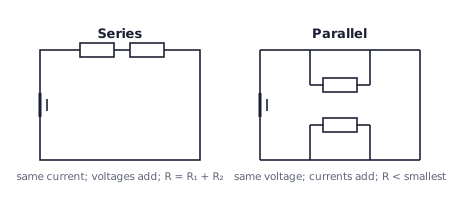
In a series circuit the current is the same everywhere and the voltages add, so . In a parallel circuit each branch has the full voltage and the currents add, so the total resistance is less than the smallest branch resistance.
Worked example
A charge of flows through a lamp in . Find the current.
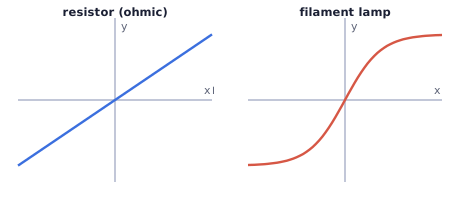
Resistance (ohms). A fixed resistor at constant temperature is *ohmic*: its graph is a straight line. A filament lamp heats up as current rises, so its resistance increases and the graph curves.
Components to know: an NTC thermistor's resistance falls as temperature rises; an LDR's resistance falls as light intensity rises; an ideal diode lets current flow one way only.
Worked example
A resistor carries when connected to . Find its resistance.
Voltage is energy per unit charge: . Power , and the energy transferred is .
Worked example
A heater draws . Find its power and the energy used in .
.
Exam tip
Three power forms come from combining with : . Pick whichever uses the two quantities the question gives you.
- Saying positive charge "flows" in electrostatics (only electrons move).
- Thinking parallel resistors give a bigger total resistance (it is always smaller than the smallest).
- Mixing up with .