

Waves & optics
Wave properties and the wave equation, reflection and refraction, sound, and the electromagnetic spectrum.
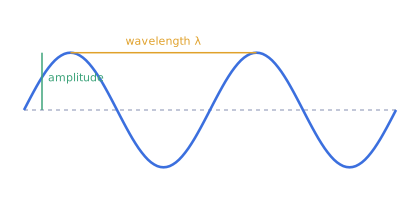
Waves transfer energy without moving matter overall. Transverse waves vibrate at right angles to travel (light); longitudinal waves vibrate along it, with compressions and rarefactions (sound). Key terms: amplitude, wavelength (), frequency () and period ().
and the wave equation .
Worked example
A wave has frequency and wavelength . Find its speed.
Waves reflect (angle of incidence = angle of reflection) and refract (change direction when their speed changes at a boundary). Slowing down bends a ray towards the normal; speeding up bends it away. Refraction changes speed and wavelength but not frequency. A moving source produces the Doppler effect, shifting the observed frequency.
Sound is a longitudinal wave made by a vibrating source and needs a medium. Louder = bigger amplitude; higher pitch = higher frequency. Reflections cause echoes. Human hearing spans to ; above that is ultrasound, used in sonar and medical scanning.
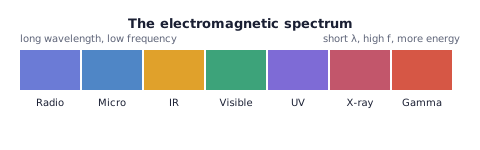
All EM waves are transverse and travel at the speed of light in a vacuum. In order of decreasing wavelength (increasing frequency): radio, microwave, infrared, visible, ultraviolet, X-rays, gamma. Higher-frequency waves carry more energy and can be more hazardous.
- Thinking waves carry matter along (they transfer energy only).
- Saying refraction changes frequency (it changes speed and wavelength).
- Getting the spectrum order reversed: radio is long wavelength, gamma short.