

Magnetism & transformers
Magnetic fields, the motor effect, electromagnetic induction, generators and transformers.
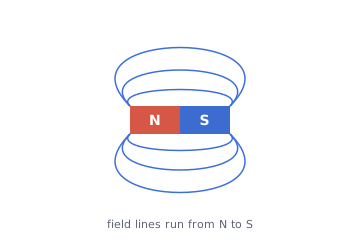
Like poles repel, unlike poles attract. Field lines run from north to south and are densest where the field is strongest. Soft magnetic materials (iron) magnetise and demagnetise easily; hard ones (steel) keep their magnetism. A magnet can induce magnetism in a nearby magnetic material.
A current creates a magnetic field around it: circular field lines around a straight wire, and a bar-magnet-like field through a solenoid (coil). The field is stronger with more current or more turns. Unlike a permanent magnet, an electromagnet can be switched off.
A current-carrying wire in a magnetic field experiences a force. For a wire at right angles to a uniform field, . Fleming's left-hand rule gives the direction (thumb = force/motion, first finger = field, second finger = current). This is the basis of the dc motor.
Worked example
A wire of length carries at right angles to a field. Find the force.
A voltage is induced when a wire cuts magnetic field lines, or when the field through a coil changes. A bigger/faster change gives a bigger voltage; reversing the motion reverses the voltage. An ac generator spins a coil in a field, producing an alternating output.
A transformer changes voltage using the turns ratio: . A step-up transformer has more turns on the secondary. Assuming 100% efficiency, power in = power out, so .
The grid transmits power at high voltage so the current is small, and therefore so are the heating losses in the cables.
Worked example
A transformer has primary and secondary turns, with input. Find the output voltage.
- Confusing the two ratios (voltage scales with the turns, current scales inversely).
- Forgetting that induction needs a *changing* field, not just a field.
- Reversing Fleming's left-hand rule fingers.