

Mechanics & motion
Kinematics and motion graphs, forces and Newton's laws, mass and weight, springs and momentum.
Scalars have size only (distance, speed); vectors have size and direction (displacement, velocity). , .
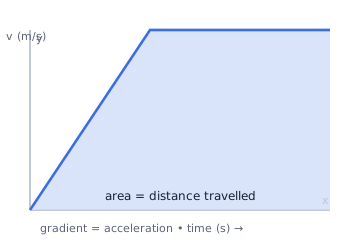
On a distance–time graph the gradient is speed. On a velocity–time graph the gradient is acceleration and the area underneath is distance. The equation of motion (constant acceleration): .
Worked example
A car accelerates from to over . Find its acceleration.
Forces include weight, normal contact, drag/air resistance, friction, magnetic, electrostatic, thrust, upthrust, lift and tension. A force diagram shows them as arrows. The resultant is the single force equivalent to them all; in one dimension, add forces in one direction and subtract the other.
- First law: a body stays at rest or moves at constant velocity unless acted on by a resultant force (its reluctance to change is inertia).
- Second law: ; a resultant force causes acceleration.
- Third law: every force has an equal and opposite reaction force *of the same type* on the other body.
Worked example
A resultant force of acts on a trolley. Find its acceleration.
Mass (kg) is the amount of matter; weight (N) is the gravitational force on it: , with on Earth. A falling object speeds up until air resistance balances its weight; the resultant force is then zero and it falls at constant terminal velocity.
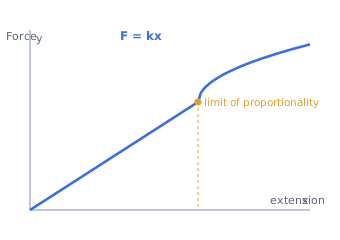
Hooke's law: . Extension is proportional to force up to the limit of proportionality. Stretch a spring too far (past its elastic limit) and it deforms permanently (inelastic). The energy stored is .
Momentum (a vector). It is conserved in collisions: total momentum before = total after. Force is the rate of change of momentum.
Worked example
A trolley at hits a stationary trolley and they stick together. Find their common speed.
Momentum before . After:
Exam tip
"Stick together" or "explode apart" questions are nearly always conservation of momentum: write total before = total after, keeping direction (sign) consistent.
- Confusing mass (kg, constant) with weight (N, depends on ).
- Reading the area of a distance–time graph as distance (only velocity–time area is distance).
- Forgetting momentum is a vector (opposite directions need opposite signs).