

Radioactivity
Atomic structure, the three types of decay and nuclear equations, ionising radiation, and half-life.
An atom is a tiny nucleus of protons (charge ) and neutrons (charge ), surrounded by electrons (charge ). Almost all the mass is in the nucleus. The atomic number is the number of protons; the mass number is protons + neutrons.
Isotopes have the same but different . Nuclide notation writes both, e.g. carbon-14 as . Ionisation is the gain or loss of electrons.
An unstable nucleus emits radiation at random. The three types:
- Alpha (): a helium nucleus ; falls by 4, by 2.
- Beta (): a fast electron from a neutron turning into a proton; unchanged, up by 1.
- Gamma (): high-energy EM radiation; no change to or .
Worked example
Complete the alpha decay .
Mass: . Proton number: (radon):
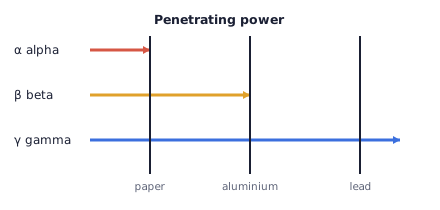
Penetration increases (alpha is stopped by paper, beta by aluminium, gamma needs lead), but ionising ability is the reverse; alpha ionises most. In a field, and deflect in opposite directions (opposite charges) and not at all. Background radiation is always present.
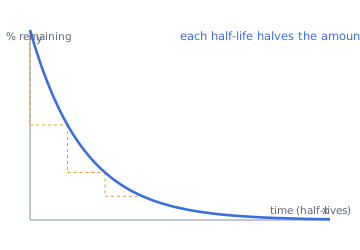
The half-life is the time for half the nuclei (or the activity) to decay. After half-lives, the fraction remaining is .
Worked example
A sample's activity is ; its half-life is . Find the activity after .
half-lives, so
Exam tip
Turn the elapsed time into a *number of half-lives* first, then just halve repeatedly. This is far quicker than any formula on a non-calculator paper.
- Mixing up penetration with ionising power (they run in opposite orders).
- Beta decay: goes up by 1, mass number is unchanged.
- Forgetting to convert the elapsed time into whole half-lives.