

Cells & organisation
Eukaryotic and prokaryotic cell structure and the levels of organisation in an organism.
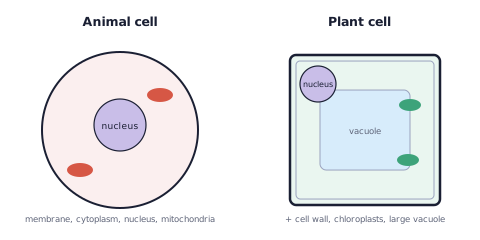
Eukaryotic cells have a true nucleus. Shared components and their jobs:
- cell membrane: controls what enters and leaves
- cytoplasm: where reactions happen
- nucleus: contains DNA, controls the cell
- mitochondrion: site of (aerobic) respiration.
Plant cells only add a cell wall (support), chloroplasts (photosynthesis) and a permanent vacuole (filled with sap).
Prokaryotic cells (bacteria) are smaller and have no true nucleus. They have a cell membrane, cytoplasm and cell wall; their DNA is a loop of chromosomal DNA free in the cytoplasm, plus small rings of plasmid DNA.
Organisms are built up in levels: cells → tissues → organs → organ systems. Cells specialise for their job, tissues are groups of similar cells, and organs combine tissues to perform a function.
Cells differentiate by switching off most of their genes and expressing only those needed for their specific job. Key examples and adaptations:
- Ciliated epithelial cells: many mitochondria for energy; hair-like cilia beat to sweep mucus (and trapped particles) along the airways.
- Red blood cells (RBCs): biconcave disc shape for a large surface area; no nucleus, leaving more space for haemoglobin; flexible to squeeze through narrow capillaries.
- Sperm cells: head contains genetic material; mid-section packed with mitochondria for energy; long flagellum (tail) for swimming.
- Nerve cells (neurones): very long axon to carry impulses over long distances; myelin sheath insulates for fast conduction; many dendrites to receive signals.
- Root hair cells: long hair-like extension gives a large surface area for absorbing water and mineral ions from the soil.
- Palisade mesophyll cells: packed with chloroplasts near the top of the leaf for maximum light absorption during photosynthesis.
- Giving animal cells a cell wall, chloroplasts or a large vacuole (those are plant-only).
- Saying bacteria have a nucleus (their DNA is free in the cytoplasm).