

Inheritance
Genetic terms, monohybrid crosses and pedigrees, and how most phenotypes arise from many genes.
Key vocabulary: a gene is a section of DNA coding for a characteristic; an allele is a version of a gene. Dominant alleles show in the phenotype with one copy; recessive need two. Homozygous = two identical alleles, heterozygous = two different. The genotype is the alleles present, the phenotype the characteristic shown. Chromosomes carry genes; autosomes are the non-sex chromosomes.
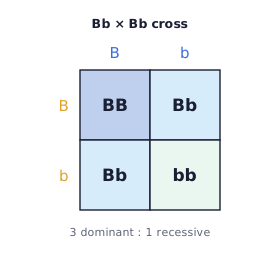
A monohybrid cross follows one gene. Use a Punnett square to combine the parents' alleles and read off the offspring ratios, probabilities or percentages. Family trees (pedigrees) trace an inherited condition through generations.
Worked example
Cross two heterozygous tall plants (Tt × Tt), where T (tall) is dominant.
Offspring: TT, Tt, Tt, tt, giving a 3 : 1 ratio of tall to short, i.e. a chance of being tall.
Some conditions follow single-gene inheritance, but most phenotypes (like height) are controlled by several genes acting together; only a few traits come from one gene alone.
Polydactyly (extra fingers or toes) is caused by a dominant allele. One copy is enough to show the condition; a heterozygous parent (Pp) gives each child a 50% chance of inheriting it.
Cystic fibrosis (CF) is caused by a recessive allele. Two copies are needed to show the condition (ff). A person with only one recessive allele (Ff) is a carrier: unaffected but able to pass the allele on. Two carrier parents have a 1 in 4 (25%) chance of an affected child. CF causes thick sticky mucus in the lungs and gut, affecting breathing and digestion.
- Confusing genotype (the alleles) with phenotype (what is shown).
- Assuming a 3:1 ratio means exactly 3 and 1 (it is a probability over many offspring).