

DNA & protein synthesis
The structure of DNA, the genetic code, how proteins are made, and gene mutations.
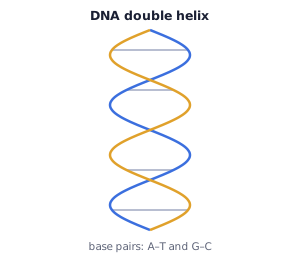
The genome is an organism's full set of DNA, held in chromosomes. DNA is a polymer of nucleotides; each nucleotide has a deoxyribose sugar, a phosphate group, and one of four bases (A, T, C or G). Two strands twist into a double helix, held by hydrogen bonds between complementary base pairs: A with T and G with C. The sequence of bases is the genetic code.
Protein synthesis builds chains of amino acids called polypeptides; one or more polypeptides form a functional protein, whose 3-D shape is set by its amino-acid sequence. The base sequence of a gene is read in triplets, and each triplet codes for one amino acid, so the gene's sequence determines the protein.
A gene mutation changes the base sequence in the DNA. This may alter a triplet, coding for a different amino acid → altered protein structure → changed or lost function.
Most mutations have no effect on the phenotype because:
1. Large stretches of DNA between genes do not code for proteins, so mutations there are irrelevant.
2. Silent mutations: the base change alters a triplet but it still codes for the same amino acid (the genetic code has redundancy), so the protein is unchanged.
Occasionally a mutation critically changes a protein; for example, altering an enzyme's active site so it no longer fits its substrate.
- Getting the base pairs wrong: it is A–T and G–C.
- Thinking every mutation changes the organism (most have no effect).