

Organ systems
The nervous, respiratory, circulatory, digestive and excretory systems.
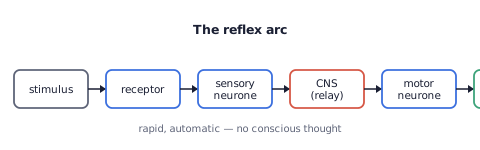
The central nervous system (CNS) is the brain and spinal cord. Signals travel along sensory, relay and motor neurones, crossing gaps called synapses. A reflex arc gives a fast, automatic response: receptor → sensory neurone → relay (CNS) → motor neurone → effector.
The breathing system (including the thorax) brings air to the lungs. Ventilation moves air in and out; gas exchange swaps oxygen into the blood and carbon dioxide out. A large surface area : volume ratio (the alveoli) makes exchange efficient.
The circulatory system has the heart, blood vessels and blood. The three vessels: arteries (carry blood from the heart, thick walls), veins (return blood, have valves) and capillaries (thin walls for exchange).
Blood components and roles: red blood cells carry oxygen; white blood cells make antibodies and carry out phagocytosis; platelets clot the blood; plasma transports dissolved substances (hormones, antibodies, urea, CO₂) and distributes heat. Multicellular organisms need exchange surfaces and a transport system because of their small surface area : volume ratio.
The digestive system breaks food down. Peristalsis pushes food along; digestion breaks large molecules into small ones; absorption takes them into the blood; egestion removes undigested waste.
The excretory system, mainly the kidneys (with the nephron as the working unit), removes waste and helps maintain a constant internal environment (homeostasis).
- Mixing up the vessels: arteries away from the heart, veins back to it.
- Forgetting why exchange surfaces matter (the surface area : volume ratio).