

Atomic structure
Sub-atomic particles, atomic and mass number, electron configurations, isotopes and relative atomic mass.
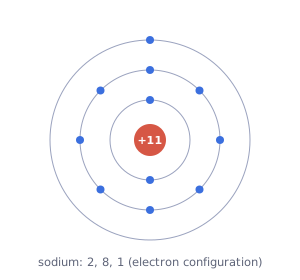
An atom has a central nucleus of protons (relative charge , mass ) and neutrons (charge , mass ), surrounded by electrons (charge , mass ) in shells. Almost all the mass is in the nucleus.
The atomic number = number of protons; the mass number = protons + neutrons. In notation , a neutral atom has electrons and neutrons; for an ion, adjust the electrons by the charge.
Isotopes are atoms of the same element (same ) with different numbers of neutrons (different ). Mass-spectrometer data gives their abundances.
Worked example
How many protons, neutrons and electrons are in ?
Protons ; neutrons ; electrons (one extra for the charge).
Electrons fill shells from the inside out, holding at most for the first 20 elements. Write the configuration as comma-separated numbers, e.g. potassium (19) is 2,8,8,1.
The relative atomic mass is the average mass of an element's atoms, weighting each isotope by its abundance.
Worked example
Chlorine is and . Find .
A mass spectrometer measures the masses and relative abundances of isotopes, giving a mass spectrum:
- x-axis: mass-to-charge ratio (); since ions carry a charge, equals the mass number.
- y-axis: relative abundance (height of the peak).
The tallest peak is the most abundant isotope. To calculate , multiply each by its abundance, sum them, and divide by the total abundance:
Worked example
A boron mass spectrum shows two peaks: (height 25) and (height 75).
- Forgetting to adjust electrons for an ion's charge.
- Confusing mass number (protons + neutrons) with (a weighted average).
- Overfilling a shell (the first three hold 2, 8, 8).