

Bonding, structure & states
Ionic, covalent and metallic bonding, how structure controls properties, and the three states of matter.
An element contains one type of atom; a compound has different atoms chemically bonded; a mixture is not chemically bonded and can be separated physically. Atoms react to gain a full outer shell, the stable arrangement of a noble gas. The type of bond depends on the atoms involved.
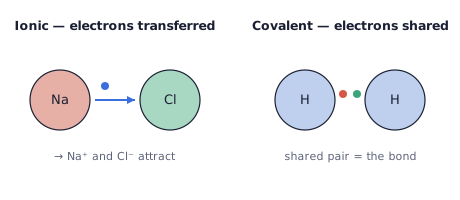
Ionic bonds form when a metal transfers electrons to a non-metal, making oppositely charged ions that attract. Predict charges from the Group: Group 1 → , Group 2 → , Al → , Group 16 → , Group 17 → . Know compound ions such as and . When a metal has more than one charge, a Roman numeral shows it, e.g. iron(III) chloride is .
Ionic compounds form giant lattices: high melting points, and they conduct electricity only when molten or dissolved (ions free to move).
Worked example
Find the formula of the compound of and .
Balance the charges: one needs two , giving
A covalent bond is a shared pair of electrons between non-metals. Substances are either small molecules (water, ammonia, methane), with low melting points and no conductivity, or giant covalent structures (diamond, graphite, silicon dioxide) with very high melting points.
Metals are a giant lattice of positive ions in a sea of delocalised electrons. The free electrons explain why metals conduct electricity and heat, and the strong attraction gives high melting points.
Between molecules there are weak intermolecular forces; melting and boiling a molecular substance overcomes these (not the covalent bonds), so it happens at low temperatures. Always relate structure and bonding to properties such as melting point and conductivity.
In a solid particles are packed and vibrate in place; in a liquid they touch but move; in a gas they are far apart and fast. Changes of state (melting, boiling, freezing, condensing) change the spacing and movement; the energy needed depends on the strength of the bonding/intermolecular forces.
- Saying ionic solids conduct: they only conduct when molten or in solution.
- Thinking boiling a molecular substance breaks covalent bonds (it breaks the weaker intermolecular forces).
- Not balancing ion charges when writing a formula.