

The periodic table & group chemistry
How the table is arranged, the link to electron configuration, and the trends in Groups 1, 17 and 18.
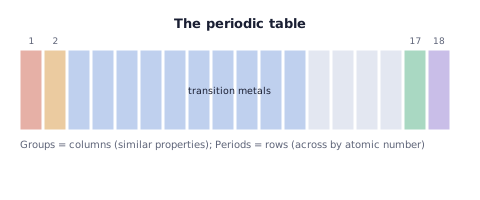
Elements are arranged by increasing atomic number. Periods are rows; Groups are columns (numbered 1–18, IUPAC). Metals are on the left and centre, non-metals top-right. Key groups: alkali metals (1), alkaline earth metals (2), the transition metals (centre), halogens (17) and noble gases (18).
The Group number (1, 2, 17, 18) gives the number of outer-shell electrons, and the Period gives the number of occupied shells. Elements in the same Group have similar chemistry because they have the same number of outer electrons.
The alkali metals (Li, Na, K…) are soft, low-density metals that all react with water to form a metal hydroxide (alkali) and hydrogen gas:
Going down the group, reactivity increases, as the outer electron is further from the nucleus and lost more easily. Observable differences when reacting with water:
- Lithium: reacts slowly; floats and moves on the surface; steady fizzing; does not melt; crimson flame.
- Sodium: reacts faster; floats and melts into a silver ball; dissolves quickly; yellow-orange flame.
- Potassium: very rapid; self-ignites immediately; lilac flame; may explode.
The halogens (F, Cl, Br, I) are reactive non-metals. Going down the group, reactivity decreases. A more reactive halogen will displace a less reactive one from a solution of its salt.
Worked example
Chlorine added to potassium bromide solution:
Chlorine (more reactive) displaces bromine.
The noble gases (He, Ne, Ar…) are unreactive because they have full outer shells. This stability is why other atoms react: to gain a noble-gas electron arrangement.
- Saying reactivity increases down every group: it increases down metals but decreases down non-metals (halogens).
- Forgetting a halogen only displaces a less reactive one.