

Organic chemistry
Hydrocarbons from crude oil, alkanes and alkenes, polymers, alcohols and carboxylic acids.
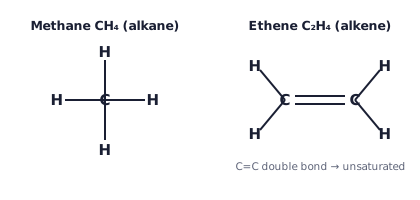
Crude oil is the main source of hydrocarbons, separated by fractional distillation. Longer chains have higher boiling points, higher viscosity and lower flammability. Cracking breaks long alkanes into shorter alkanes and alkenes. A homologous series is a family with the same functional group and general formula; molecules can show structural isomerism (same formula, different arrangement). Formulae may be written as molecular, full structural (displayed) or condensed.
Complete combustion (plenty of oxygen) gives carbon dioxide and water; incomplete combustion gives carbon monoxide or soot.
Alkanes are saturated hydrocarbons, general formula (methane, ethane, propane, butane, pentane, hexane). Alkenes are unsaturated, with a double bond, general formula .
Alkenes turn bromine water from orange to colourless; this is the test for unsaturation. They undergo addition reactions with hydrogen, halogens, hydrogen halides and steam.
Worked example
Combustion of propane:
In addition polymerisation, many alkene monomers join (the C=C opens) to form a long saturated chain, e.g. ethene → poly(ethene). In condensation polymerisation, monomers join with a small molecule (like water) lost, forming polyesters and polyamides (amino acids join this way to make proteins). Polymers may be biodegradable or not. You should recognise the repeating unit from a monomer and vice versa.
Alcohols have the group, general formula (methanol, ethanol…); they react with sodium to release hydrogen. Carboxylic acids have , general formula ; they behave as weak acids (forming salts) and react with alcohols (acid catalyst) to make esters.
- Mixing up the general formulae: alkanes , alkenes .
- Forgetting the bromine-water test goes orange → colourless for alkenes.
- Confusing addition with condensation polymerisation.