

Electrolysis
The electrolysis cell, what happens at each electrode, predicting products and writing half-equations.
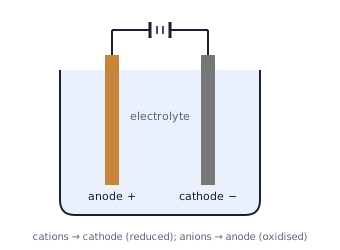
Electrolysis uses electricity to break down an electrolyte (a molten or dissolved ionic compound). The cathode is the negative electrode, the anode the positive one. Direct current is used, since alternating current would keep swapping the electrodes.
At the cathode, cations (positive ions) gain electrons (reduction). At the anode, anions (negative ions) lose electrons (oxidation). For molten binary compounds the metal forms at the cathode and the non-metal at the anode. For aqueous solutions there is competition: at the cathode hydrogen is released unless the metal is less reactive than hydrogen.
Worked example
Write the cathode half-equation for the electrolysis of molten sodium chloride.
(Sodium ions are reduced at the cathode.)
Electrolysis can coat an object with a thin metal layer (electroplating) by making the object the cathode in a solution of the plating metal's ions, useful for protection or appearance.
- Swapping the electrodes (the cathode is negative, attracting positive ions).
- Forgetting the water competition in aqueous solutions.
- Unbalanced electrons in half-equations.