

Rates of reaction
What changes a reaction rate, collision theory, activation energy and catalysts.
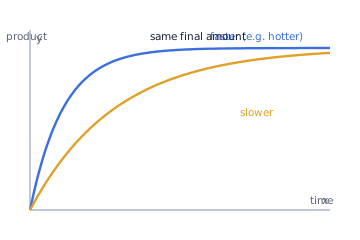
Rate increases with concentration, temperature, smaller particle size (bigger surface area), a catalyst, and, for gases, higher pressure. Measure rate by following the loss of a reactant or the gain of a product (mass, gas volume or another property) over time.
Particles react only when they collide with enough energy and the right orientation. The minimum energy needed is the activation energy . Anything that makes collisions more frequent or more energetic speeds the reaction up.
A catalyst speeds up a reaction without being used up. It provides an alternative route with a lower activation energy, so more collisions succeed. It is chemically unchanged at the end and does not shift the position of an equilibrium.
- Saying a catalyst is "used up" (it is regenerated).
- Thinking a catalyst increases the yield at equilibrium (it only speeds things up).
- Confusing concentration with the total amount.