

Coordinate geometry
Equations of straight lines, the equation of a circle in both forms, and the circle properties used in proofs.
Coordinate geometry connects algebra and shape: lines, circles, and the standard circle properties. Knowing the circle equation in both forms is essential.
A line can be written as (point–gradient form) or . Parallel lines share a gradient; perpendicular gradients satisfy .
Worked example
Find the line through and .
Gradient . Then , i.e.
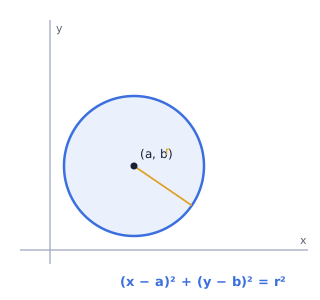
A circle with centre and radius is . Expanded, it takes the form ; complete the square in and to recover the centre and radius.
Worked example
Find the centre and radius of .
Centre , radius .
The properties used in proofs:
- The perpendicular from the centre to a chord bisects the chord.
- A tangent is perpendicular to the radius at the point of contact.
- The angle at the centre is twice the angle at the circumference on the same arc.
- The angle in a semicircle is .
- Angles in the same segment are equal.
- Opposite angles of a cyclic quadrilateral sum to .
- The alternate segment theorem: the angle between a tangent and a chord equals the angle in the alternate segment.
Exam tip
"Tangent ⊥ radius" turns many circle problems into a right-angled triangle you can attack with Pythagoras, so look for it whenever a tangent appears.
- Reading the centre as instead of from .
- Forgetting that the radius is , not , after completing the square.
- Using for perpendicular lines instead of .