

Differentiation
The derivative as a gradient, differentiating powers of x, and finding tangents, normals and stationary points.
The derivative gives the gradient of the tangent to a curve, the instantaneous rate of change. Differentiation lets you find tangents, normals and turning points.
For (any rational ), . Differentiate sums term by term; constants differentiate to . Notation: , , and the second derivative , .
Worked example
Differentiate .
Rewrite :
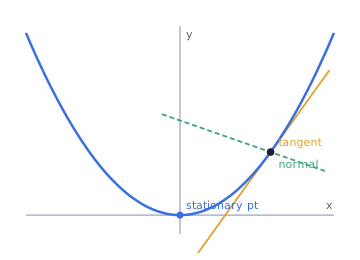
The gradient at a point is evaluated there. The normal is perpendicular to the tangent, so its gradient is .
Worked example
Find the tangent to at .
at ; the point is . Tangent: , i.e.
At a stationary point . Classify with the second derivative: gives a minimum, gives a maximum. A function is increasing where and decreasing where .
Worked example
Find and classify the stationary points of .
. Since : at it is (minimum), at it is (maximum).
- Forgetting to rewrite terms like or as powers before differentiating.
- Using the tangent gradient for the normal (it should be the negative reciprocal).
- Mixing up the max/min test: is a minimum.