

Algebra & functions
Rational indices, surds, quadratics and the discriminant, simultaneous equations, inequalities, polynomial division and the factor theorem.
Mathematics 2 builds on the algebra of Maths 1 and adds the tools used throughout the rest of the module: completing the square, the discriminant, polynomial division, the factor and remainder theorems, and the language of functions.
The index laws hold for all rational exponents: , with and (for ).
Simplify surds with and rationalise denominators using the conjugate. The convention is that means the positive root.
Worked example
Simplify .
Multiply by the conjugate . Denominator: .
A quadratic can be solved by factorising, by the formula , or by completing the square.
The discriminant controls the roots: two real roots, one repeated root, no real roots. This is a favourite ESAT tool for "for what values of …" problems.
Worked example
For what values of does have equal roots?
Equal roots ⇒ :
Worked example
Complete the square for .
Factor out : Minimum value at .
Solve a linear + quadratic pair by substitution: rearrange the linear equation and substitute into the quadratic, giving a single quadratic to solve.
Worked example
Solve and .
Substitute:
So or , the two points where the line meets the circle.
Solve linear inequalities like equations (flip the sign when multiplying/dividing by a negative). For a quadratic inequality, find the roots, sketch the parabola, and read off where it is above or below the axis.
Worked example
Solve .
Roots of are . The upward parabola is positive outside the roots:
Exam tip
For a "" with an upward parabola, the answer is the outside region; for "", it is between the roots. A quick sketch prevents the most common sign error here.
Polynomials can be divided by a linear or a quadratic (algebraic long division), leaving a quotient and remainder.
Remainder theorem: the remainder when is divided by is . Factor theorem: is a factor exactly when . Use it to find one root, then factorise what remains.
Worked example
Show is a factor of , and factorise fully.
, so is a factor. Dividing gives
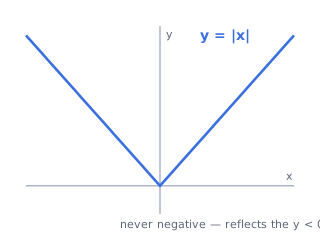
A function maps each input to exactly one output; it may be many-to-one (like ) or one-to-one. Two functions to know precisely: always means the positive square root, and (the modulus) gives the size of with its sign removed, so .
- Treating as rather than .
- Getting the region wrong for a quadratic inequality (always sketch).
- Forgetting the "" when a discriminant or square root gives two values.