

Integration
Indefinite and definite integrals of powers, the area under a curve, and the trapezium rule.
Integration reverses differentiation, and a definite integral measures the area between a curve and the -axis. The two ideas are linked by the Fundamental Theorem of Calculus.
For : . Raise the power by one and divide by the new power. The constant is needed for an indefinite integral.
Worked example
Find .
Expand first:
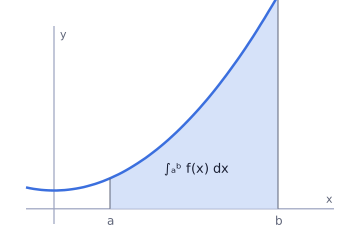
A definite integral is evaluated between limits: where (the Fundamental Theorem of Calculus). It gives the (signed) area between the curve and the axis.
Worked example
Find .
Exam tip
A definite integral gives signed area: a region below the axis counts as negative. If a question asks for the total physical area and the curve crosses the axis, split the integral at the crossing point.
When a curve cannot be integrated easily, the trapezium rule estimates the area by splitting it into thin trapezia. For a curve that bends upward (convex) the rule overestimates; for one that bends downward (concave) it underestimates.
You can also solve simple differential equations of the form by integrating both sides.
- Omitting "" on an indefinite integral.
- Using when (the rule fails there).
- Treating signed area as physical area when the curve dips below the axis.