

Graphs & transformations
Sketching the standard functions, the four graph transformations, and reading roots and intersections from graphs.
You should be able to sketch the standard functions on sight and predict how transformations move them. Graphs also let you read off roots and the solutions of simultaneous equations.
Recognise lines, quadratics, cubics, the trig functions, logarithmic and exponential functions, the square root , and the modulus . Key features to mark: intercepts, turning points and any asymptotes.
For , the graph is a parabola with turning point , scaled by (and flipped if ). For , tilts the line and slides it up or down.
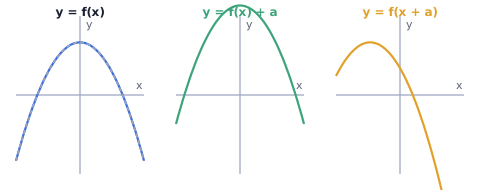
Starting from :
- : shift up by .
- : stretch vertically by factor .
- : shift left by (inside changes act backwards).
- : stretch horizontally by factor .
These can be combined, and composed as .
Exam tip
The rule of thumb: changes outside the function affect and behave as you expect; changes inside affect and do the opposite of what they look like ( moves left, not right).
Where a graph crosses the -axis are the roots (); use differentiation to locate turning points and decide the shape. A polynomial of degree has at most real roots.
The points where two graphs intersect are exactly the solutions of their equations solved simultaneously, a powerful way to interpret or check algebra graphically.
Worked example
Where does meet ?
Set equal: . They meet at and .
- Shifting the wrong way (it moves left for ).
- Confusing a vertical stretch with a horizontal one .
- Assuming a cubic always has three real roots; it can have one.