The graph of aˣ, the laws of logarithms, and solving equations of the form aˣ = b.
🕐 8 min read
A logarithm is the inverse of an exponential: it answers "what power gives this number?". Logs turn equations with the unknown in the exponent into ones you can solve.
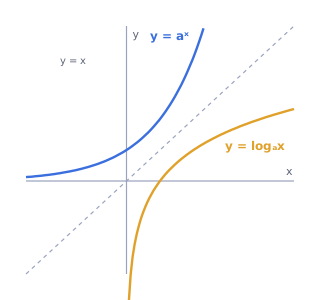
y = aˣ and y = logₐx are inverses: reflections of each other in the line y = x.
y=ax (for a>1) passes through (0,1) and grows rapidly; its inverse y=logax passes through (1,0). They are reflections in the line y=x.
The definition: ab=c⟺b=logac. The laws:
logax+logay=loga(xy)
logax−logay=loga(yx)
klogax=loga(xk)
loga(x1)=−logax and logaa=1.
Worked example
Write 2loga3+loga5 as a single logarithm.
loga32+loga5=loga(9×5)=loga45.
Take logs of both sides to bring the power down: ax=b⇒x=logalogb. Some equations reduce to this form after a substitution.
Worked example
Solve 25x−3×5x+2=0.
Let y=5x (so 25x=y2): y2−3y+2=0⇒(y−1)(y−2)=0.
5x=1⇒x=0, or 5x=2⇒x=log5log2.
Exam tip
When you see a2x and ax together, substitute y=ax, turning the equation into a quadratic you already know how to solve.
Writing log(x+y) as logx+logy; the law is for log(xy).